Company Biography
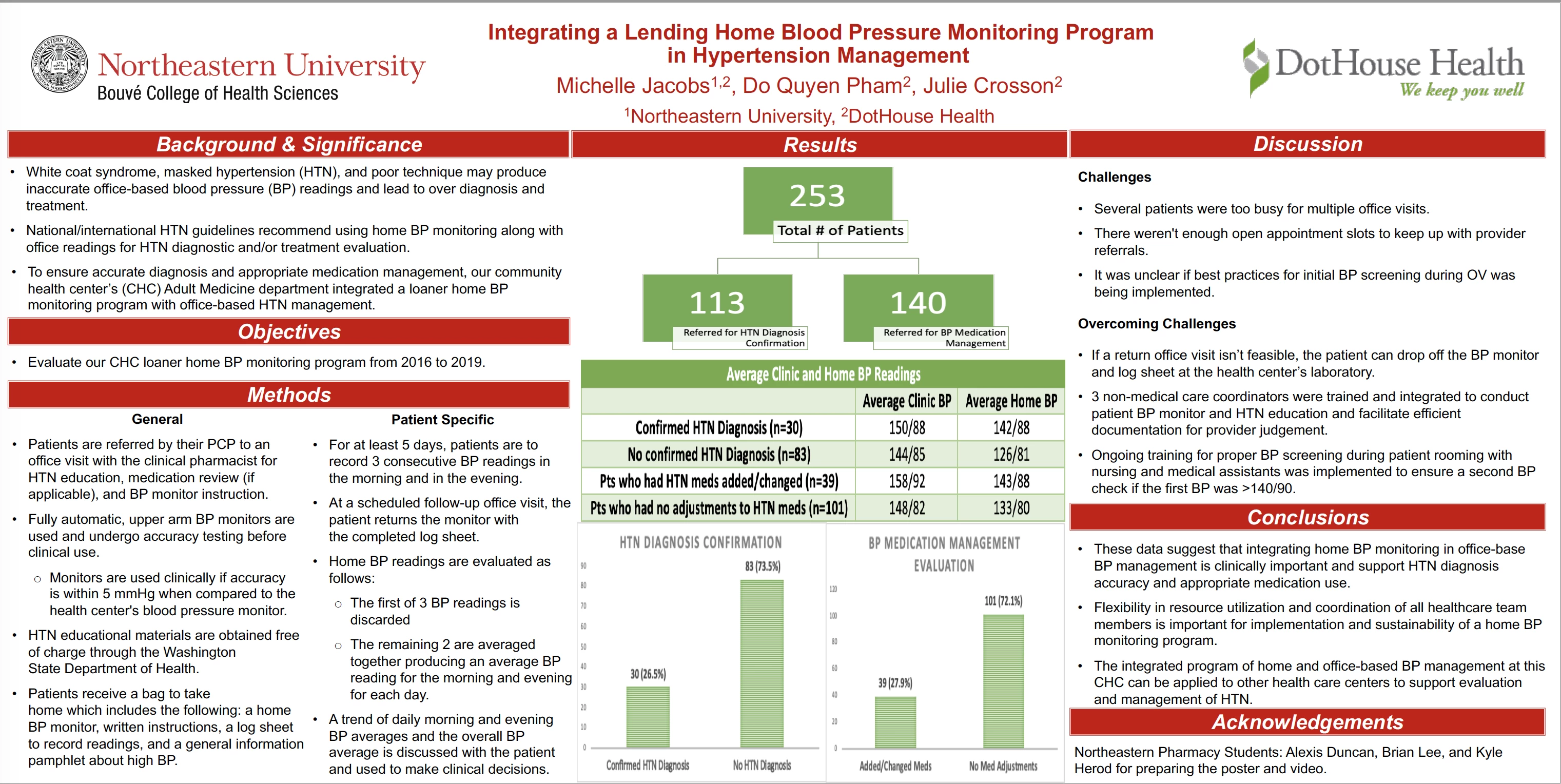
CP32 - Integrating a Lending Home Blood Pressure Monitoring Program in Hypertension Management
Poster Type: Innovation
Category: Quality of Care and Quality Improvement
Issue or Challenge: White coat syndrome, masked hypertension (HTN), and poor technique may produce inaccurate office-based blood pressure (BP) readings and lead to over diagnosis and over treatment with antihypertensive agents. National and international HTN guidelines along with the US Preventative Services Task Force recommend using home BP monitoring in conjunction with office readings for HTN diagnostic and/or treatment evaluation.
To ensure accurate diagnosis and appropriate medication management, our community health center’s Adult Medicine department integrated a loaner home BP monitoring program with office based HTN management. This report details the program from 2016 through 2019.
Description of Innovation: The loaner home BP monitoring program is an innovation to support primary care providers in their decision making while engaging patients in their health monitoring. Seeing that primary care providers are often faced with limited time and competing priorities, our clinical pharmacist developed a home lending BP monitoring program to collect blood pressure readings that better reflect a patient’s actual condition. Having the more accurate readings followed up in a later appointment allowed providers to maximize their clinical judgment and adjust treatment options accordingly. Incorporated in the program are BP medication refill histories from the patient’s pharmacy to evaluate BP medication refill adherence.
The program began with a few providers but expanded to all providers in Adult and Family Medicine departments and is currently an integrated part of HTN management in the health center.
Impact or Result: From 2016 through 2019, 253 patients were referred for either HTN diagnosis confirmation (n=113) or for BP medication management evaluation (n=140). For those patients referred for HTN diagnosis confirmation, 30 patients were confirmed to have HTN (average clinic BP 150/88; average home BP 142/88) and 83 patients did not have HTN (average clinic BP 144/85; average home BP 126/81). For those patients referred for BP medication management evaluation, 39 patients had medications adjusted or added (average clinic BP 158/92; average home BP 143/88) and 101 patients did not have their BP medications adjusted (average clinic BP 148/82; average home BP 133/80).
These data suggest that integrating home BP monitoring in office-based BP management is clinically important and may have impact ensuring HTN diagnosis accuracy and appropriate medication use.
Replicating this Innovation: Important features to any home blood pressure loaner program includes using validated meters (preferable with an AC adapter rather than batteries), direct patient instruction on how to use and document multiple readings over several days, ensuring patient engagement through disease and results education, and defining a pre-determined method how the results are relayed to the provider for evaluation.
We have found that having separate office visits from the primary care provider and defined clinical staff to facilitate the program has resulted in a sustainable program, allowing us to expand from Adult Medicine to Family Medicine.
Author(s):
Michelle Jacobs, PharmD, CDE, BCACP, Assistant Clinical Professor, Northeastern University
Julie Crosson, MD, Internist, DotHouse Health
Do Quyen Pham, MPH, Quality and Reporting Coordinator, DotHouse Health
Contact Information
Team Members

Julie Crosson
DotHouse Health
Internist
Michelle Jacobs
Northeastern University
Assistant Clinical Professor